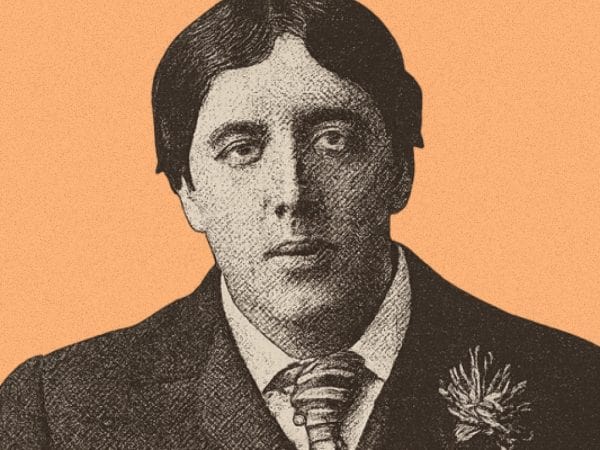
Oscar Wilde was a master of words. Sharp, funny, and fearless in how he used them. Born in Dublin in 1854, he became one of the most celebrated writers of his time, famous for turning everyday observations into lines that still stop us in our tracks more than a century later. Whether he was writing about love, truth, or the absurdities of polite society, Wilde somehow had a way of exposing how people really think and feel.
His wit often masked a deeper message: to live honestly, love boldly, and see beauty even in imperfection.
The quotes below capture the spirit of Wilde at his best: Clever, courageous, and surprisingly relevant to modern life.

To love oneself is the beginning of a lifelong romance.
Oscar Wilde
At first, this sounds like a throwaway joke about vanity, but Wilde rarely wrote without layers, and here he’s touching on something far deeper: That self-acceptance is the foundation of happiness.
To talk about loving oneself in Victorian society bordered on scandalous. Wilde turns convention on its head, suggesting that self-regard isn’t arrogance. If you don’t like who you are, how can you live truthfully?
Today, the line feels even more relevant. The ability to appreciate yourself, your choices, your flaws, and your growth in today’s age is a superpower. Wilde reminds us that love isn’t only something we give or receive. It’s also something we cultivate within.

We are all in the gutter, but some of us are looking at the stars.
Oscar Wilde
This line from Lady Windermere’s Fan (1892) is one of Wilde’s most beloved. It’s spoken by Lord Darlington, a character who flirts with cynicism but still clings to hope.
In a single sentence, Wilde captures the duality that defines much of human life: We all face flaws, struggles, and disappointments, yet some of us choose to look upward.
The “gutter” isn’t meant to shame. It’s simply where we find ourselves as imperfect people. The stars, on the other hand, symbolise the imagination, ideals, and beauty we reach for despite it all. Wilde understood that hope and hardship coexist. Optimism isn’t denial, but defiance.

The truth is rarely pure and never simple.
Oscar Wilde
This line comes early in The Importance of Being Earnest (1895), spoken by Algernon Moncrieff, a character who delights in turning serious ideas upside down. It’s a line that works as both a joke and a warning.
Wilde wrote in an era obsessed with appearances and propriety, where people pretended life was tidy and morals were absolute. Truth, Wilde suggests, is complicated. It’s a mix of emotion, perspective, and even self-interest. Truth then, can rarely be separated cleanly from the people telling it.
Rather than trying to purify truth, this idea invites us to accept its complexity and to recognise that the world is layered, people even more so.
It’s a line that makes you smile first, then pause, then wonder how much of your own truth has been edited to appear simple.

Experience is simply the name we give our mistakes.
Oscar Wilde
This line appears in Lady Windermere’s Fan (1892), one of Wilde’s most successful comedies. Wilde suggests that experience isn’t something you acquire from books or lectures; instead, it’s what remains when things haven’t gone to plan. We gain experience the hard way, through our mistakes, regrets, and moments we’d rather forget. Calling those mistakes “experience” doesn’t excuse them, but we can reframe them as part of the process of becoming wiser.
Wilde himself lived this philosophy. His brilliance was matched by scandal, imprisonment, and even exile. This line feels almost autobiographical, acknowledging that wisdom rarely comes cheaply, and that the stories we’re proud to tell often begin with the ones we’d rather not tell.

The aim of life is self-development. To realise one’s nature perfectly — that is what each of us is here for.
Oscar Wilde
Wilde’s philosophy of life was rooted in beauty, art, and the pursuit of individuality. He believed that the highest purpose a person could have was self-realisation. That is, the act of becoming fully and unapologetically yourself.
In Victorian England, this was a radical idea. Society expected people to play their parts quietly and respectably. Wilde, by contrast, celebrated difference. To “realise one’s nature perfectly” meant embracing the traits, talents, and contradictions that made you unique, rather than trying to mould yourself into something acceptable to others.
To live truthfully is to live beautifully, even when that beauty doesn’t meet others’ standards.

I can resist everything except temptation.
Oscar Wilde
Nobody could make a confession sound charming quite like Oscar Wilde. Whilst playful on the surface, underneath the humour is something real. Oscar Wilde understood that people aren’t as disciplined as they like to pretend. We all have moments where desire wins, and he thought that was nothing to be ashamed of.
For him, temptation wasn’t a sign of weakness; it was proof of being alive. His characters flirt with danger, cross lines, and learn about themselves in the process. He knew that resisting every impulse might look virtuous, but it often means missing out on experience, pleasure, and truth.
This line still makes people smile because it’s honest, funny, and a little freeing. Wilde reminds us that you don’t have to be spotless to be sincere, you just have to be self-aware enough to laugh about it.

The very essence of romance is uncertainty.
Oscar Wilde
This line comes from The Importance of Being Earnest and cuts straight to the heart of why romance feels so exciting and so frustrating. The uncertainty that Wilde talks about isn’t a flaw in love. In fact, it’s what makes it electric.
In the play, the character speaking isn’t making a grand statement about destiny. He’s half-joking, half-honest, admitting that the thrill of romance comes from not knowing exactly where it’s going.
Wilde saw love as a mix of mystery, risk, and imagination. The moment everything becomes predictable, it stops being romance and starts being routine.
It’s a funny, almost mischievous way of describing something serious. This is a simple reminder that if love feels uncertain, it’s probably because it’s real.

No man is rich enough to buy back his past.
Oscar Wilde
This line comes from Mrs Cheveley, a sharp and calculating character in An Ideal Husband. She’s speaking to a man whose wealth and status can’t erase the mistakes he’s made.
No matter how powerful or successful someone becomes, the past remains stubbornly out of reach. Wilde’s own life was built on dazzling charm and brilliance, but was also undone by scandal, making this quote feel prophetic when read in hindsight.
If we can’t buy back the past, we also don’t owe it endless repayment. Wilde seems to suggest that the only honest way forward is through acceptance. Learn from what’s behind you, but don’t keep trying to purchase forgiveness, it’s not for sale.

A cynic is a man who knows the price of everything and the value of nothing.
Oscar Wilde
This may sound like a throwaway jab, but it’s really a critique of anyone who measures life purely in numbers, what something costs, what it earns, what it’s worth on paper.
The “price” is easy to calculate, but “value” is harder. Beauty, kindness, meaning, joy: Those things don’t fit neatly into a ledger, which is exactly why cynics miss them.
This line cuts through all the pretence to remind us that being clever is one thing, but being able to see value where others don’t is real intelligence.

It is only shallow people who do not judge by appearances. The true mystery of the world is the visible, not the invisible.
Oscar Wilde
This line comes from The Picture of Dorian Gray, his famous novel about beauty, vanity, and the masks people wear. On the surface, it sounds backwards. Aren’t we taught not to judge by appearances? But as usual, Wilde turns the idea inside out to make a point.
He isn’t saying appearances are everything. He’s saying they’re something (and often more revealing than we admit). The way a person dresses, moves, or presents themselves can express their truth just as powerfully as their words.
For a writer who loved style, this was personal philosophy. He believed beauty had meaning, that the things we see and touch are part of what makes life worth living.
It’s a reminder to pay attention to surfaces not as distractions, but as reflections of what lies within.

Life is far too important a thing ever to talk seriously about.
Oscar Wilde
Oscar Wilde loved a contradiction, and this one might be his best. How could something as important as life not be taken seriously? But the irony here is deliberate. He’s reminding us that taking life too seriously often means missing its joy.
By joking about life’s importance, he invites us to loosen our grip a little. When we’re too earnest, too careful, we stop noticing the absurdity and beauty that make living worthwhile.
This quote reads almost like advice from someone who’s seen both sides of life: It demands attention, yes, but it also demands lightness.

When one is in love one always begins by deceiving one’s self, and one always ends by deceiving others. That is what the world calls a romance.
Oscar Wilde
This line from The Picture of Dorian Gray shows Wilde is neither romantic nor hopeful; he’s brutally observant.
Love, he suggests, often starts with the stories we tell ourselves. We imagine what we want to see, not what’s really there. Eventually, that illusion spills outward, shaping how we act and what we say.
It’s a sobering take on romance, but actually not a cynical one. He isn’t dismissing love. He’s reminding us that it begins in imagination. We fall for ideals, for potential, for the version of someone that exists partly in our own minds.
Wilde had no illusions about human nature, but he never stopped finding poetry in it. This line holds both truths at once: Love can blur our vision, and it can open our eyes, and sometimes it can do both.
Oscar Wilde had a way of telling the truth that made people laugh first and think later. His words have lasted because they capture what it feels like to be human. Whether he was writing about love, truth, or temptation, he managed to turn ordinary moments into insights that still make sense today.
What stands out most is how lightly he carried big ideas. Wilde never preached, and that’s why his writing still feels alive; it’s like holding up a mirror and letting you recognise yourself in the reflection.
Deep dive into the wonderful world of motivational quotes with Quotivated. Download the App for Free


