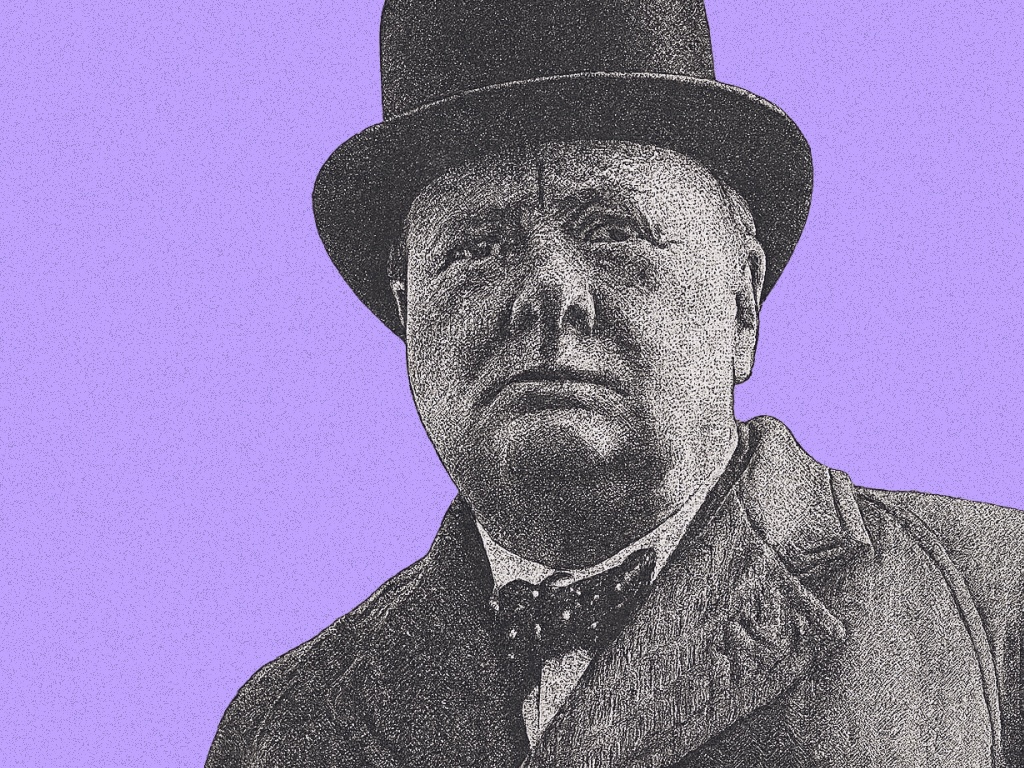
Through war, political setbacks, and social change, he encouraged people to face hardship with grit and to keep striving for something greater. These eight quotes, all taken from his original speeches and writings, show how he set goals, looked to the future and evaluated his own and others’ performance in life.

Men and kings must be judged in the testing moments of their lives.
Winston Churchill
This quote appears in Churchill’s 1931 profile of Spain’s King Alfonso XIII (later included in Great Contemporaries). When reflecting on the king’s decision to leave Spain to avoid civil war, Churchill wrote: “Men and kings must be judged in the testing moments of their lives”. It emphasises that leaders’ true character is revealed during crises. By highlighting that reputations are forged under pressure, Churchill argued that courage matters most when circumstances are terrible. The line encourages readers to judge rulers not by speeches but by how bravely they act when the stakes are high. Churchill admired King Alfonso’s willingness to abdicate to spare Spain from bloodshed. His observation reflects his broader belief that moral courage may require sacrificing personal power for the greater good.

To improve is to change; to be perfect is to change often.
Winston Churchill
Whilst its origin is debated, this quote was said to have been spoken in the Commons on the 23rd June 1925, predating many of his more well-known speeches and quotes. It suggests that perfection involves accepting a change of course, whether that’s in a particular work strategy, social behaviour, or even by switching perspective. Whilst it would be argued that no one is perfect, sticking to old habits is perhaps not the way to seek perfection.

The price of greatness is responsibility.
Winston Churchill
This quote was spoken to an American audience at Harvard University in 1943. The phrase was part of a wider context of the role and burden of global leadership, especially in relation to the wartime responsibilities that Churchill was facing. Interpreted for the modern day, this quote could be interpreted to mean that in order to seek greatness, we must show accountability and responsibility for any wrongdoings or mistakes made along the way.

Never, never, never give up.
Winston Churchill
Likely one of Churchill’s most well-known quotes, these words were first uttered at Harrow School on 29 October 1941. This quote is a paraphrase of the words officially recorded to have been spoken: “never give in, never give in, never, never, never, never – in nothing, great or small … never give in except to convictions of honour and good sense”.
The quote is straightforward to interpret: to seek what you want to achieve, you never, never, never give up. Perseverance and consistency are key to achieving a goal. It’s not uncommon for actors to achieve fame only in their later years, or for businesses to only start generating profit after years of trial and error.

Difficulties mastered are opportunities won.
Winston Churchill
This quote was mentioned on the 21st March 1943 address, in the context of post-war planning. He reflects on the enormous challenges ahead (reconstruction, rehabilitation of war-torn nations, managing demobilisation, economic reorganisation) and frames them as “difficulties to be mastered.”
This quote is a welcome, supportive message in times of struggle, whether that’s a challenging work task, improving a complicated relationship, or achieving another personal goal. Any difficulty overcome is in itself a win, and should be treated as such.

I never worry about action, but only inaction.
Winston Churchill
This quote was sourced from a piece of private war correspondence written by Churchill on the 7th December 1940. This was in a letter to General Sir John Dill. Churchill was pushing for an energetic, decisive effort and criticising approaches that were too cautious.
In the modern day, this can be used as a valuable tool for motivation. We don’t achieve our aims and goals by simply doing nothing. Worrying about potential outcomes and letting that hinder our ability to proceed is less effective than giving things a go and taking action on what we feel we need to achieve a goal.

It is always wise to look ahead, but difficult to look further than you can see.
Winston Churchill
This quote appears in the publication, “Sir Winston Churchill: A Self-Portrait” (1954). Throughout his career, Churchill balanced his vision for strategy with caution. He valued long-term planning, whether in politics, military affairs, or rebuilding post-war Britain, but also recognised that excessive speculation or overconfidence could be dangerous.
Translated into modern-day life, this quote could be interpreted to tell us that planning the future and setting ambitious goals for it is great, but to keep a small sense of realism in mind when planning and looking ahead in life to avoid disappointment. This is not to discourage, but to not set yourself up for failure when the future holds so many unknowns.

Solitary trees, if they grow at all, grow strong.
Winston Churchill
This quote was dictated in The River War, a book written by Churchill in 1899. Churchill wrote The River War early in his career. The quote in its full context is shown below;
“Solitary trees, if they grow at all, grow strong: and a boy deprived of a father’s care often develops, if he escape the perils of youth, an independence and a vigour of thought which may restore in after life the heavy loss of early days”
Interpreting this quote, it could be said that those who have faced hardship, either via facing challenges alone or any other type of deprivation, grow stronger and more resilient as a result. It encourages those who have encountered difficulties in their life to feel motivated that it can be used as a tool for success, rather than a factor which holds them back. The quote fits with Churchill’s recurring themes: resilience, self-reliance, and character built through challenge.
Final Thoughts
Winston Churchill’s words continue to resonate because they stem from a life defined by resilience, adaptability, and courage in the face of adversity. Whether reflecting on perseverance, leadership, or personal growth, his quotes remind us that progress is rarely straightforward – it comes from trial, error, and persistence. Nearly a century later, his reflections still serve as practical motivation: to act decisively, to keep improving, and to face challenges not with fear, but with audacity and strength.
Deep dive into the wonderful world of motivational quotes with Quotivated. Download the App for Free


